
Propel provides innovative insurance solutions to thousands of companies across the country. We make it our business to know your world inside and out.
Claims & Risk Management, Commercial, Insights, Manufacturing, Transportation
EV Fires: An Environmental Liability Risk Many Businesses Don’t See Coming
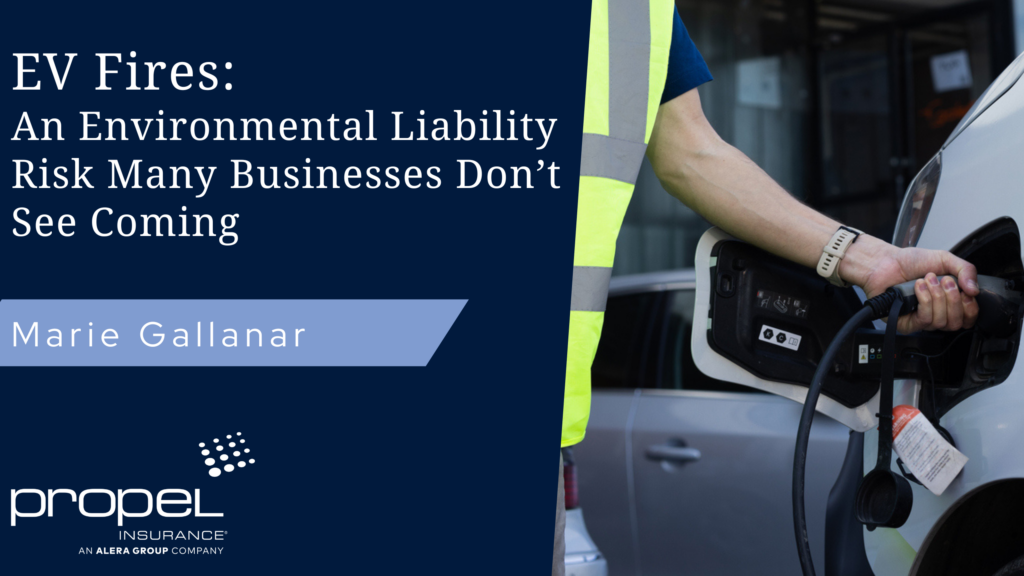
Most business leaders would not describe their companies as “environmental risks.” Yet an increasing number of businesses are being exposed to environmental liability—not because of what they manufacture, but because of electric vehicles.
Here’s the issue:
Lithium-ion battery fires behave very differently from traditional vehicle fires. When an EV catches fire, whether it belongs to your company, an employee, or a customer, fire departments often must use large volumes of water or specialized suppression agents to extinguish it.
That firefighting effort can create contaminated runoff containing metals and chemical byproducts from the battery. If that runoff enters a storm drain, soil, or nearby waterway, it can trigger an environmental response.
And this is where many businesses are surprised.
In these situations, liability often follows the property and operations, not fault. Municipalities are frequently required to respond and seek recovery of cleanup costs from potentially responsible parties, which may include:
- Property owners
- Facility operators
- Businesses where the incident occurred
We see this more often when the vehicle owner is uninsured or underinsured, even though the business did nothing wrong. While these incidents may not hit the news (they are typically settled between the municipality and the property owner directly), we are seeing them come through as potential claims. What makes this exposure especially challenging is the insurance gap.
Most Commercial General Liability (CGL), Property, and Umbrella policies exclude pollution and environmental cleanup costs. Many companies assume they’re covered—until they’re not.
And this risk isn’t limited to customer parking lots.
Many organizations now operate:
- Company-owned EV fleets
- Electric forklifts and material handling equipment
- Yard trucks or delivery vehicles
- EV charging infrastructure
A battery fire involving any of these assets—parked, charging, or operating—can create the same environmental exposure as a third-party vehicle.
Key takeaway:
You do not need to create environmental waste to have environmental liability.
If EVs are present on your property, whether they’re yours or your customers’, you may already have an exposure that requires standalone Environmental / Pollution Liability insurance.
As EV adoption accelerates faster than insurance programs evolve, this is one of those risks that’s far easier (and less expensive) to address before there’s an incident.
If this topic hasn’t been part of your risk or insurance conversations yet, it’s worth putting on the agenda.
Want to understand what this exposure could mean for your locations or fleet? Contact Marie Gallanar or your Propel team to learn more.

Marie Gallanar
With nearly 20 years of experience in financial services, including a decade in insurance and eight years in banking, Marie brings a well-rounded perspective to her work with clients. She specializes in supporting manufacturers across industries, including consumer products, aerospace, and heavy industrial, including businesses with Department of Defense contracts. Marie takes pride in helping clients navigate complex risks from the shop floor to the global supply chain.