Propel provides innovative insurance solutions to thousands of companies across the country. We make it our business to know your world inside and out.
Claims & Risk Management, Commercial, Insights, Real Estate
Tsunami Risk in the Pacific Rim: Coverage Gaps Real Estate Developers and Contractors Can’t Afford to Ignore
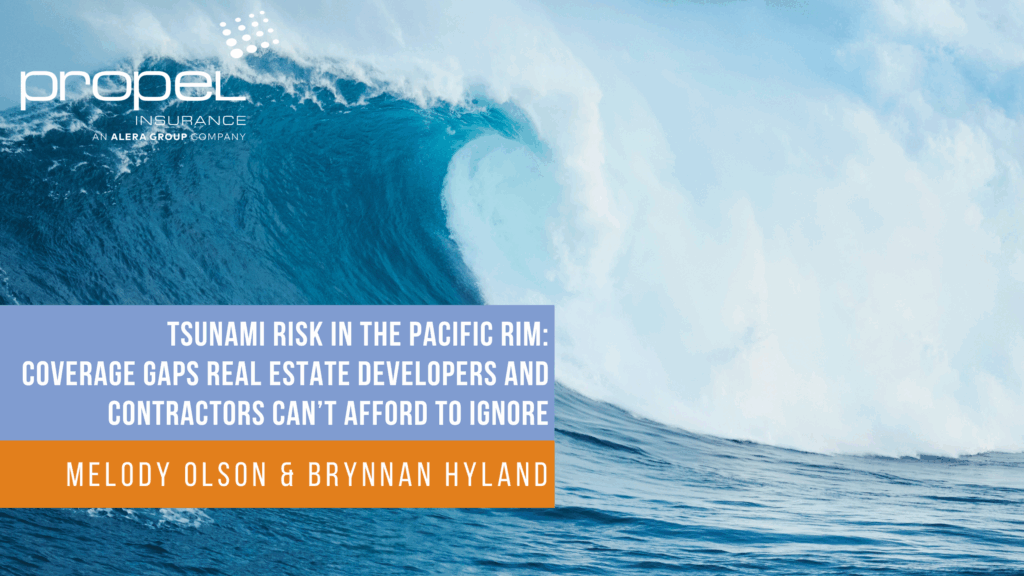
The Pacific Rim’s tectonic volatility makes it one of the most seismically active—and tsunami-prone—regions on Earth. For owners with coastal real estate exposure, a single offshore earthquake can wipe out millions in assets within minutes.
It’s not just the direct destruction of buildings or projects at stake. Today’s large-scale developers/owners face cascading consequences: financing disruptions, construction delays, contract breaches, environmental liabilities, and insurance shortfalls that threaten entire portfolios. The real risk isn’t just the wave, it’s the aftermath, and whether your insurance strategy is strong enough to absorb the blow.
A Recent Reminder: The Kamchatka Wake-Up Call
On July 29, 2025, an 8.7-magnitude earthquake near the Kamchatka Peninsula triggered tsunami warnings from Alaska to California. While coastal communities largely avoided damage this time, the event was a stark reminder that the threat is real and recurring.
This was not a fluke – it was part of a pattern. It’s a matter of when, not if.
The Five Most Costly Coverage Gaps Facing Developers and Contractors
Despite the large assets and exposures involved, many commercial property owners and construction firms remain critically underinsured. Here are the most overlooked and potentially crippling insurance gaps:
1. Flood and Earthquake Exclusions
-
Standard commercial property and builder’s risk policies exclude both flood and earthquake perils, the two essential ingredients of tsunami losses. If you haven’t included earthquake coverage or secured flood insurance, you may be left un-covered.
-
Typically Overlooked Fact: NFIP flood coverage maxes out at $500,000 per building—often grossly inadequate to cover the replacement cost of buildings in even modest development portfolio footprints. NFIP also does not compensate for loss of income under the policy coverage, which creates an uncovered cash flow exposure in the event of a large-scale event.
2. Loss Limit Inadequacy
-
Flood and earthquake coverage is often purchased on a loss limit basis, a structure that does not cover the full values of the building/asset. In high-density urban environments or portfolios with coastal exposure, this can lead to underinsurance if limits are not reviewed and modeled on a consistent basis, especially when adding or removing locations throughout the policy term. This can result in portfolios being underinsured and leave the owner to be on the hook for additional out of pocket costs.
-
Pro Tip: Use Probable Maximum Loss (PML) and Scenario-Based Modeling to evaluate your program limits based on worst-case events and your risk tolerance.
3. Business Interruption (BI) Gaps
-
Post-disaster business interruption losses can eclipse physical damage—especially if your insurance only kicks in with direct damage, and not when roads are closed, utilities are down, or government-mandated evacuations stall work.
-
Hidden Risk: Standard business interruption clauses often exclude off-site utility outages, even if those cause months of delay. Check for utility service interruption and ingress/egress extensions.
4. Project Risk: Soft Costs & Delay in Completion
-
If your coverage doesn’t include soft costs (think interest, marketing, legal fees, leasing incentives, loan carrying costs), every delay hits your balance sheet twice: once in lost timeline, again in lost cash flow. Many builder’s risk policies may not adequately address delay in completion, especially for public-private or infrastructure-heavy deals. Something your broker should walk through in detail with you.
-
Key Consideration: Are your coverage extensions addressing your project’s soft cost and delay exposures?
5. Evacuation Expense Coverage
-
Tsunami warnings often trigger mandatory evacuations of job sites, residential buildings, and commercial properties. These evacuations can result in significant costs—transportation, lodging, security, and lost productivity. Yet most property policies do not automatically cover these expenses.
What to Look For:
-
Civil Authority Coverage: This extension may reimburse costs when access to your property is restricted by government order.
-
Evacuation Expense Endorsements: Some carriers offer specific coverage for evacuation-related costs, including temporary relocation and site security.
-
Extra Expense Coverage: This can help offset the cost of maintaining operations during displacement, including renting alternate facilities or accelerating repairs.
What Should Real Estate Owners and Developers Consider?
It’s not enough to have a basic off the shelf property policy and assume coverage is sufficient. If you’re managing a real estate portfolio, your insurance should function like a tailored risk transfer strategy, not an afterthought.
Actionable Strategies to Close Gaps
-
Conduct a Comprehensive Risk and Policy Audit: Use catastrophe modeling and third-party engineering assessments to recalibrate risk.
-
Secure Layered Flood & EQ Coverage: Go beyond NFIP—consider excess flood coverages and specialized earthquake coverages tailored to your asset base.
-
Review Soft Cost Allocations Periodically: As projects evolve, so should your soft cost coverage. Inflation and interest rate changes demand agile insurance planning.
-
Reinforce Business Interruption Provisions: Ensure you have coverage for civil authority, utility interruption, ingress/egress, and evacuation expense to reflect real-world impacts.
-
Partner with a Broker Who Knows the Terrain: Work with advisors experienced in large-scale construction, real estate syndications, and port-adjacent developments. Cookie-cutter doesn’t cut it here.
Final Thoughts: The Cost of Doing Nothing
A tsunami may strike once in a generation, but your reputation, portfolio value, and investor trust are tested every day. High-impact events don’t just damage property; they upend projects, slow momentum, and erode your competitive edge.
Developers and Owners who take a proactive, data-driven approach to insurance planning aren’t just protecting assets, they’re safeguarding their ability to operate, deliver, and grow.
Propel’s Seattle Real Estate Team is here to assist with creating custom solutions for you and your portfolio. Please don’t hesitate to reach out for assistance or questions.

Melody Olson
Melody has spent over 20 years specializing in real estate, construction, and project risk insurance. Melody is known by clients and colleagues for having strong technical expertise, creative problem-solving skills, and relentless client advocacy. More about Melody...

Brynnan Hyland
With over a decade of industry experience, Brynnan brings a strong underwriting background with a focus on complex risks and program design. By analyzing client risk profiles and tailoring coverage solutions, Brynnan delivers clear guidance and a strategic approach to risk management.