Propel provides innovative insurance solutions to thousands of companies across the country. We make it our business to know your world inside and out.
Claims & Risk Management, Food & Beverage, Insights, Risk Management
When Vodka Ends Up in Your Energy Drink: What a Recent Recall Teaches Us About Product Recall Risk
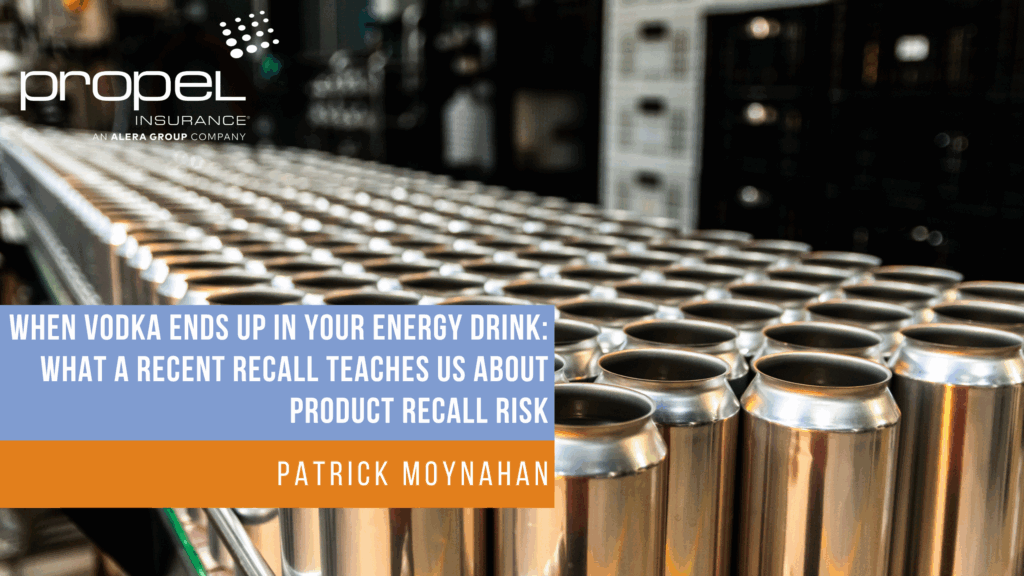
In a headline-grabbing incident this July, a leading energy drink manufacturer accidentally infused vodka into cans that were not labeled as alcoholic beverages. The result? A swift product recall, public confusion, and a harsh spotlight on quality control failures.
This wasn’t sabotage or counterfeit goods. It was a simple production error, and that’s exactly why it should send a chill down the spine of any company involved in manufacturing or distributing consumer goods.
Because if it can happen to them, it can happen to anyone.
2024 Food Safety Recall Data – What We Can Extrapolate
Food recalls aren’t just becoming more frequent, they’re becoming more dangerous.
According to Food Safety Net Services, 296 food products were recalled in the U.S. in 2024. Nearly 1,400 people were sickened. Hospitalizations jumped from 230 in 2023 to 487 in 2024, and deaths increased from 8 to 19 in the same period. Despite a slight dip in total recalls compared to the previous year, the consequences became far more severe.
Undeclared allergens remained the top cause of FDA food recalls, followed closely by pathogens like Salmonella, Listeria, and E. coli. And from January to April 2025, recalls due to foreign materials—such as plastic, glass, or metal—rose 93% compared to the same period the year prior, according to FDA data and NACS reporting.
Even with strong safety protocols in place, errors are slipping through the cracks, and the cost of those errors is growing.
Recalls Are No Longer Rare. They’re Routine.
Production environments today are fast-moving and increasingly complex. Whether you’re bottling beverages, blending chemicals, assembling kits, or packaging supplements, the margin for error is small, and the risks are growing.
Common causes of recalls include:
- Ingredient or component mix-ups
- Labeling and packaging errors
- Cross-contamination
- Undeclared allergens or active substances
- Co-packer or third-party mishandling
This recent energy drink recall wasn’t caused by spoilage or shelf-life issues. It was the wrong liquid in the wrong can. Somewhere along the production line, a process failed—whether in batch segregation, quality oversight, or automation. That’s the reality for any company managing multiple SKUs, formulas, or fulfillment partners.
The Real Cost of a Recall
When a recall hits, the financial impact is just the beginning.
Here’s what companies often face:
- Reverse logistics and customer outreach
- Legal exposure and third-party liability
- Retailer penalties and chargebacks
- Regulatory investigations
- Brand damage and media scrutiny
- Business interruption and lost contracts
Citing a report from MEIRxRS, Quality Assurance & Food Safety suggests that the average cost of a food recall is estimated to be $1,563,551 excluding brand damage and lost market share. Large companies may have the resources to weather the storm. For others, a single misstep, without the right protections, can threaten everything they’ve built.
And those numbers may be even higher today.
What Propel Clients Need to Know About Product Recall Insurance
Product Recall Insurance isn’t a luxury, it’s a lifeline. It can cover:
- Physical recall and disposal costs
- Product replacement and rework
- Legal defense and liability
- Crisis communications and PR
- Lost income due to disruption
- Regulatory compliance support
At Propel, we help clients tailor this coverage to their unique operations—whether you’re a regional food processor or a national distributor working with multiple co-packers. Our goal is to help ensure that a recall doesn’t derail everything you’ve built.
Final Word: Your Brand Is Only as Strong as Your Recall Plan
The manufacturer in this case will likely recover. But smaller and mid-sized companies may not be so lucky. A poorly managed recall can be financially devastating, and reputationally permanent.
If you haven’t reviewed your recall coverage recently, or don’t have a plan in place, ask yourself:
- Do we know what happens in a recall scenario?
- Are we protected—financially and operationally?
- Can we survive the unexpected?
Recalls are no longer a remote possibility. They’re a business reality. The only question is whether you’re prepared.
Let’s Talk
If you’re unsure about your current protections or want to explore coverage options tailored to your risk, our team is here to help. Reach out to learn more about how we can support your brand, your operations, and your peace of mind.
Sources
Quality Assurance & Food Safety: How Much Does a Food Recall Really Cost?
Food Safety Net Services — 2024 Recall Statistics
FDA Enforcement Data
NACS
MEIRxRS
