
Propel provides innovative insurance solutions to thousands of companies across the country. We make it our business to know your world inside and out.
Claims & Risk Management, Commercial, Insights, Risk Management, Senior Care
AI: Forging the Relationship of Rewards and Risks
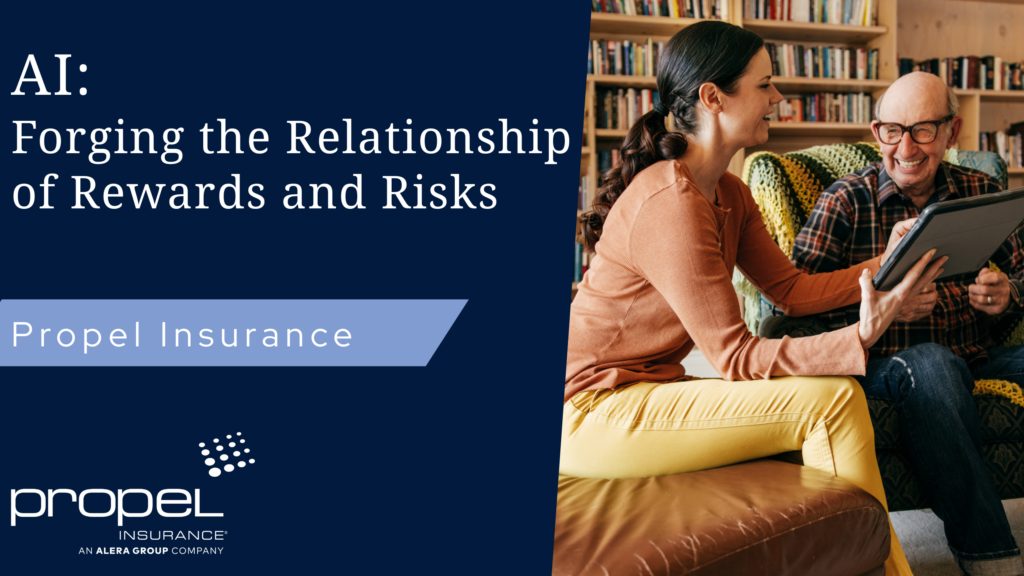
Artificial Intelligence (AI) in senior care is an application and technology term imparting the use of algorithms and cognitive functions to assist the efficiency of care and service and is rapidly transforming operational decision-making and service delivery.
Some of the most current, recognizable, advertised, and applied technologies are fall detection and management devices, but for governance and transparency, AI should be seen as a set of technologies and not a single service.
The electricity of decision-making
With increased marketing of AI products and the reliance on this expanding sector for decision-making, comes human accountability and the need for risk control.
AI requires a balanced approach leveraging the innovation while considering and managing the emerging exposures. A carefully crafted policy will serve as the framework for ethical and responsible adaptation and use of these advanced technologies.
The following briefly outlines key considerations tailored to leadership roles responsible for governance and oversight and clinical integrity.
Risk Management Considerations for Executive and Clinical Leaders
Strategic Alignment and Organizational Governance
- Ensure AI initiatives support organizational goals, resident safety priorities, and long-term strategic plans.
- Consider forming an AI Governance Committee including executives, legal, clinical leaders, IT, and risk management.
- Require clear accountability structures for approvals, implementation, oversight, and outcome monitoring.
- Evaluate the financial impact, return on investments, and resource requirements associated with AI adoption.
Data Privacy and Security
- Implement robust data governance consistent with HIPAA, state privacy laws, and internal data-access policies.
- Ensure executive review of vendor security assessments and Business Associate Agreements (BAAs).
- Prioritize enhanced cybersecurity protections—encryption, multi-factor authentication, monitoring, and periodic testing.
- Verify that any data used for model training is de-identified unless explicit consent is obtained.
Clinical Oversight and Risk Mitigation
- AI must support, not replace, clinical judgment. Leaders should establish clear expectations for their role in assessments, monitoring, or decision support.
- Require protocols for validation of AI-generated alerts or recommendations, including clinician review.
- Train staff on automation bias and potential inaccuracies in predictive models.
- Maintain documentation standards that capture how AI output informed care decisions without serving as the sole determinant.
Algorithm Transparency and Bias Prevention
- Select AI partners that provide transparency regarding data sources, model design, and performance validation.
- Conduct periodic audits of AI outputs to identify potential biases impacting resident populations.
- Implement a multidisciplinary review process for new AI tools, focusing on fairness, reliability, and safety.
Workforce Readiness and Change Management
- Provide training for all clinical and operational staff regarding safe AI use, workflows, and limitations.
- Monitor impacts on staffing, workload, and care processes; adjust operational plans to maximize efficiency and resident outcomes.
- Communicate the purpose, benefits, and limitations of AI tools to foster adoption and reduce resistance.
Ethical Considerations and Resident Rights
- Ensure AI-enhanced monitoring or engagement tools uphold resident dignity and autonomy.
- Obtain informed consent when AI tools introduce audio, video, biometric, or continuous monitoring capabilities.
- Establish policies that prevent AI from replacing meaningful human interaction.
Continuous Monitoring and Quality Improvement
- Require ongoing review of system performance, adverse events, errors, or unintended consequences.
- Benchmark results against quality, safety, and resident experience metrics.
- Maintain awareness of evolving AI regulations, best practices, and emerging risks.
Legal and Regulatory Considerations
- Operators have an ethical and legal obligation to be transparent about the use of AI with residents, their families, and staff.
- Explain how data is used and how AI influences care plans or administrative decisions such as staffing models or pricing.
- Obtaining clear, informed consent from residents, especially those with diminished capacity, is a complex challenge that needs careful navigation. Legal should be consulted in these matters.
- Vendor contracts must clearly define liability in case of errors, data ownership, intellectual property rights, and indemnification to protect the operator from third-party claims.
For executive and clinical leaders, the safe integration of AI in senior care requires a proactive governance structure, ongoing evaluation, and clear alignment with mission, compliance requirements, and resident-centered values. With thoughtful oversight, AI can strengthen operational efficiency, enhance care delivery, and support strategic growth while minimizing organizational risk.
As AI continues to shape the future of senior care, thoughtful governance and risk management will be critical to adoption. Connect with Propel’s Senior Care team for more resources and to discuss how your organization can navigate emerging AI exposures while supporting innovation and resident-centered care.
